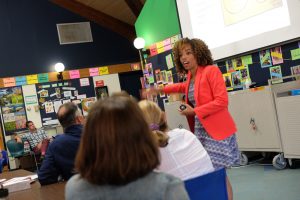
Dena Simmons had some hard-earned advice for teachers: consider the backstory of each student in your class. From her childhood in the Bronx, NY, to boarding school in Connecticut, to a successful career in higher education, Simmons, who leads the聽, brought her personal narrative to a recent faculty meeting. She shared difficult boarding school memories: a teacher publicly correcting her diction; walking into a dorm room and seeing the resident guarding valuables in Simmons鈥� presence; and being asked, 鈥淲here are you from? No, where are you聽from聽from?鈥� She said she didn鈥檛 fit in at school but eventually absorbed聽the cultural rules.
鈥淚 learned to erase myself to survive,鈥� said Simmons, who is biracial. 鈥淭here is damage done when people cannot be who they are.鈥�
Simmons encouraged teachers to cultivate their own emotional intelligence, which is defined as the ability to monitor one鈥檚 own and others鈥� feelings, to discriminate among those feelings, and to use this information to guide one鈥檚 thinking and actions. Simmons said that using emotional intelligence within the framework of being culturally responsive, or taking the time to learn about a student鈥檚 unique cultural background and experiences, help classroom leaders聽take into account that students start with baggage that may not be obvious or visible. This also gives teachers insights into the array of positive attributes that students may be shielding from view.
鈥淚t鈥檚 important to bring the world into our classroom, because what matters most is to support the rich strengths of our students,鈥� she said. 鈥淲e want our students to thrive, because we want to prevent Charlottesville, Missouri, Charleston.鈥�
See Dena Simmons鈥� TED talk聽.